
ART-ificial: the rise of AI in the art world24/03/2026Author: Sophie Coxon
Art and technology: an evolutionary leap Art has been used as an instrument of expression and conversion between humans since our ancient ancestors roamed the globe. In its many forms, flavours and styles, art has evolved with us, filling our homes, hearts and lives over thousands of years and enabling us to communicate complex responses to subjects and events beyond the often limiting medium of words. At its very core, art is a way for us as human beings to connect, challenge, and relate, crossing the boundaries of culture, language, and even time. Its value is rooted in the ability for emotions to be both expressed and evoked, preserving fragments of history in an animated, evocative manner that texts and manuscripts cannot compete with. By its very essence, art is emotion - and so the recent emergence of art generated by artificial intelligence has swept the earth with new and unexpected impacts, both good and bad, and its unpredictability is causing discomfort for many as the creative realm rapidly evolves, and requires us to adapt.
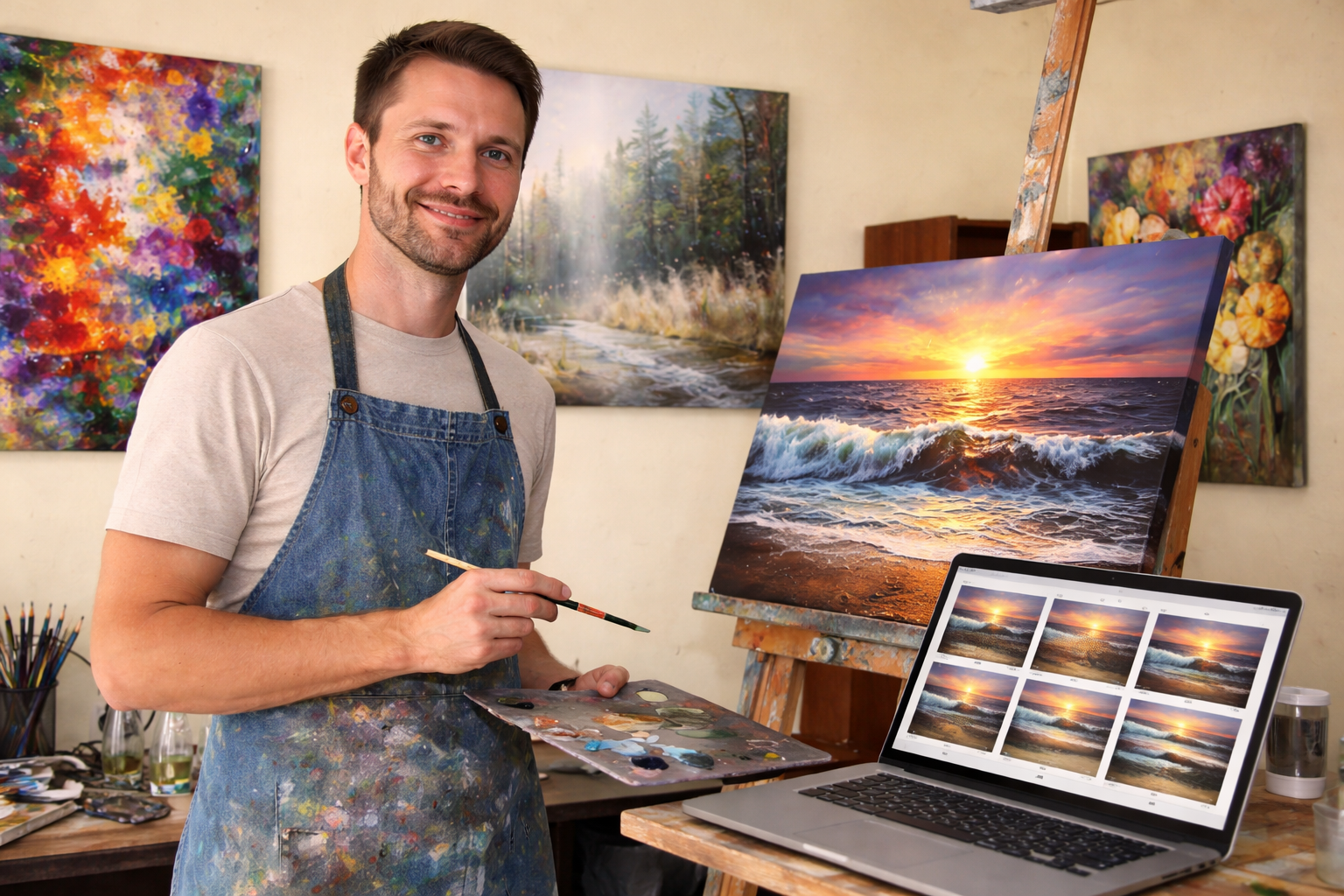
The positives: creative process assistance AI assistants have become a mainstream addition to daily life, and are at artists’ fingertips night and day. This has brought a huge amount of opportunity to artists, who now have access to a personal assistant that can streamline ideas, help brainstorm narratives and concepts, fact-check and test concepts quickly, and generate condensed descriptions of work without losing crucial elements. Artists have free range to test colours, generate patterns and visualise their work within simulated interiors or settings, at no cost - in time, money or resources - and with no mess. This has opened the door for many new artists and designers to creating, exploring and developing their work, without the traditional barriers that used to accompany this. In 2024, close to half (45.7%) of artists asked said that they found AI useful during the creative process, demonstrating just how widespread its use and influence is.
The negatives: market flooding and outcompeting human art Despite the creative tools it provides, the injection of AI into the art world has sunk a hefty weight at the other end of the scale too. Suddenly, anybody can generate images within seconds, in any style, without the forethought, planning and practice that this used to require. The market has been flooded with AI-generated images of everything, from overly-realistic animals to copyist prints of famous and iconic works. Hotel lobbies, which once supported local artwork, now display garishly coloured and unimaginable scenes of local tourist attractions, whilst fabric shops host row upon row of poorly printed digitised motifs that have no culture, story, or human craftsmanship behind them. It has become increasingly difficult to distinguish reality from synthetics, human handiwork from artificial copies. And in a time of drastic overconsumption and throw-away consumerism, AI-generated art, which can be rapidly mass-produced, altered and distributed across seemingly anything and anywhere, is the cheapest and most efficient form of producing visuals for homes and interiors. Which, naturally, has left many small-scale and independent artists and designers struggling to have their work valued, displayed and appreciated. Demand is shifting in favour of artworks produced by machines, which lack the capacity to produce anything new - making everything a regurgitation of something that already exists. However, the reality is that most people would prefer to have real, original and authentic art and design in their homes and lives. There is a surface-level, laminated feeling to everything generated by AI, and the lack of emotional motive, meaning and creativity can be sensed almost immediately. Without creative intuition and the ability to produce completely novel ideas, AI itself cannot progress art forward, only recycling and reproducing what has already been created. Ultimately, this is where our significance as human beings lies: sentience. Art has been a direct way of telling our stories without needing anything more than passion, feeling, and a medium of expression. AI has only the latter of these three components, and therefore, still requires at least some level of human input, salvaging a tiny fraction of our power. commodifying aesthetics can never be fully separated from human stories, and we are the sole input of lived experience.
The future outlook: a (precarious) paradox Whilst the future prospects for skilled artists may seem locked in a futile battle against this technological revolution and era of change, all is not lost, and really, there could be a silver lining. Like releasing a new species into an ecosystem, the impacts cannot be predicted and risks potentially devastating or positively transformative consequences. The invention of the camera was expected to snuff out the need for the slow and arduous process of painting, when a scene could be snapped in minutes to absolute realism and to the finest perfect detail. However, this actually pushed the boundaries of art, enabling waves of creativity onto canvases through expressive colour, brushwork and play with line and shape, in ways that a camera could not. Suddenly, artists had broken free from the goal of photorealism and no longer bore the responsibility of recording life. The meaning of art began to shift, leading to an explosion of colour, rapid brushwork, blurred lines and exaggerated concepts bloomed, initiating the birth of movements such as Impressionism and Cubism. The camera not only freed up the creative spirit of artists; new concepts and ideas were transferred from photography to painting, such as unusual cropping and playing with light. It supported the exploration of new corners of the artistic landscape, challenged traditional views, and undoubtedly benefited both artists and viewers.
In similar fashion, AI may initiate a turning point in how we as society perceive and value art. If the age of technology has taught us anything, it is that humans crave connection beyond the glass barrier of screens. This has never been clearer than during the COVID-19 pandemic, where lockdowns globally restricted access to human interaction, connection and community, and many suffered with immense feelings of isolation, loneliness and despair, despite being possibly the most digitally connected we have ever been. And so - applying this to the world of art - the future is not all doom and gloom, and we as both creators and consumers of art, hold the power to determine its value. If we choose to recognise and cherish the deeper sentiment of art and the unique story of each artist, and reject the ultra-processed, digitised and synthetic copies being generated by robots, the significance of authentic and original pieces grows, and creates a niche and market in society where true creativity is paid its due respect. Change lies in the small decisions, the fine details, such as the fabrics we select and the businesses - or individuals - we support. In the wise words of William Morris, ‘Have nothing in your house that you do not know to be useful, or believe to be beautiful.’
About the writer
|
ART-ificial: the rise of AI in the art world |
Comments
Sean Bw Parker - 04/04/2026 00:00
Before his death Dilbert creator Scott Adams was tracking the rise of AI, and quickly worked out that, while it had its uses, AI would never replace real art. That's because art is actually about the person making it as much as the thing itself, and the fact that there's a person making it. Articles like this are important, as despite the trillions being poured into AI, creatives have turned against it en-masse, now understanding it to be vapid, pointless, endlessly replicable slop, far worse than photocopying or digital art. AI is a blip, a trend, something that will be remembered as a brief 'thing', and nothing more.